Estimation
20 March 2012 No Comments Yet - Share Your Thoughts
Do the red lines below appear to bow outward? Or are they parallel?
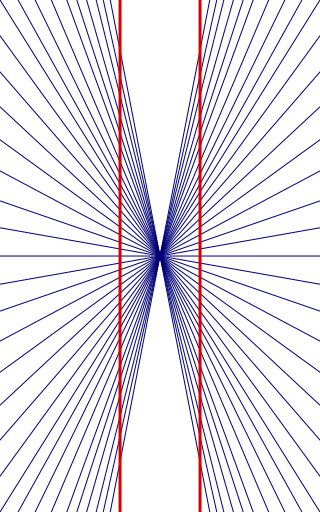
The red lines are straight and parallel and do not bow outward despite their appearance. This illusion, known as the Hering illusion, was discovered in 1861 by a German physiologist named Ewald Hering. The Hering illusion produces the opposite effect of the Wundt illusion.

Loading...
Tagged in estimation, hering, lines
Estimation
19 March 2012 No Comments Yet - Share Your Thoughts
Do the red bars appear perfectly straight and parallel?
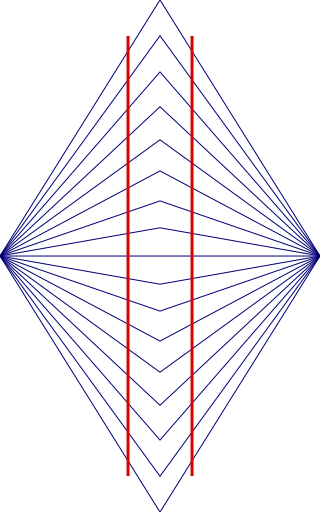
The lines are straight and parallel. Some viewers will perceive the lines to bow inwards due to the angles of the blue lines. This illusion was first observed by German psychologist Wilhelm Wundt during the 19th century. The Wundt illusion produces the opposite effect of the Hering illusion.
Loading...
Tagged in estimation, lines, wundt
Estimation
16 March 2012 No Comments Yet - Share Your Thoughts
These three horizontal lines are all the same length. Does the middle line appear to be longer than the top line?
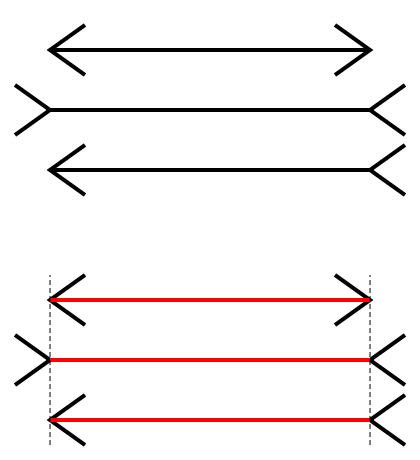
The arrows on the end of the lines give the impression that the lines are different lengths. The red horizontal lines help to show that they are all equal. This is known as the Müller-Lyer Illusion and was discovered in the late 19th century.
Loading...
Tagged in arrows, estimation, lines, muller-lyer
Ambiguous
15 March 2012 No Comments Yet - Share Your Thoughts
While it does not look like much, the wire frame drawing of a cube below is actually an ambiguous optical illusion. The cube can be seen in one of two ways. Either the lower left face or the upper right face can be seen as the front most surface of the cube. Can you flip-flop between the two interpretations?
 This illusion is named the Necker Cube as it was discovered by Louis Albert Necker in 1832.
Loading...
Tagged in ambiguous, cube, necker
Estimation
14 March 2012 No Comments Yet - Share Your Thoughts
In 1939, William Orbison described the following illusion where the red square appears to be distorted by the presence of the angled blue lines.
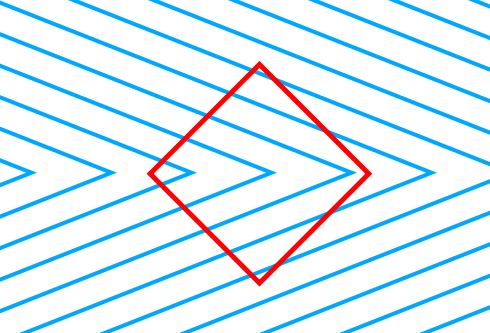
It does not look to be a perfect square, but if you take a sheet of paper or something else with a straight edge and line it up, you will see that it is.
Loading...
Tagged in estimation, lines, orbison
Impossible
13 March 2012 No Comments Yet - Share Your Thoughts
The Penrose triangle was first created by Oscar Reutersvärd in the 1930’s. It is also referred to as the Penrose tribar or the impossible triangle. A figure of this shape could not possibly exist in the real world because of the way that it bends.
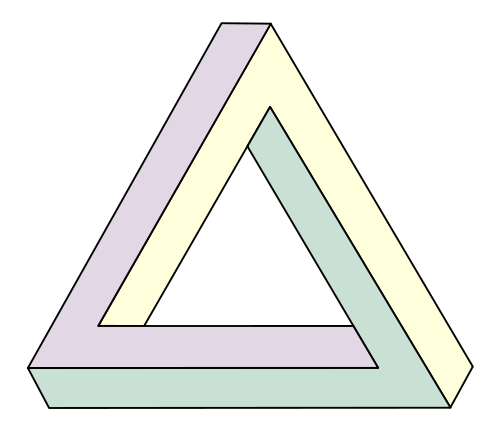 It is, however, possible to create an impossible triangle that works when viewed from one specific angle.
Loading...
Tagged in oscar reustersvard, penrose, triangle, tribar
Estimation
12 March 2012 No Comments Yet - Share Your Thoughts
Do the black lines presented below appear to be parallel?

The black lines are indeed parallel even though they do not appear to be. In 1860, this classic optical illusion was discovered by Johann Karl Friedrich Zöllner. This illusion was the basis for the discovery of the Poggendorff illusion.
Loading...
Tagged in estimation, lines, zollner


 (2 votes)


