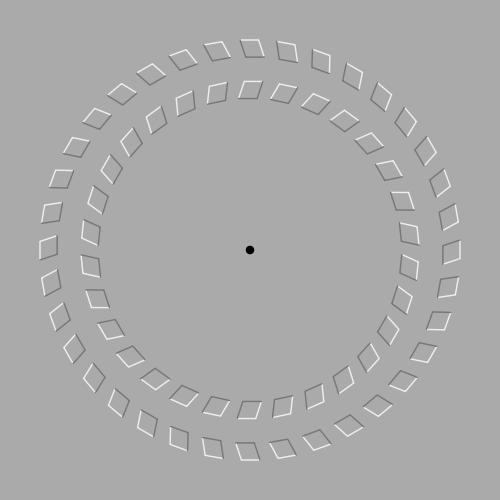
Look at the black dot in the center of this image and move your head closer to your screen and then back again. Do the outer circles appear to be moving?
This illusion, known as the Pinna illusion, was the first visual illusion to show a rotating motion effect. It was discovered by Dr. Baingio Pinna.
Brusspup had to drain his pool and used the opportunity to create a new anamorphic illusion. When standing in a specific spot, a blue #2 pool ball can be seen in the pool. From all other angles, the ball is distorted.
Additional footage related to the creation of this optical illusion can be viewed by reading the full post.
In the late 19th century, Quaker Oats released a pamphlet with an optical illusion on the cover. The paper that the Quaker Man is holding below reads , “How many packages can you count?” Do you see six or seven packages of Quaker White Oats? Both answers are correct depending on how you look at this ambiguous drawing.
The Eiffel Tower, named after its engineer Gustave Eiffel, was erected in 1889 in Paris, France for the 1889 World’s Fair. The tower measures over 1,000 feet in height. From 1889 to 1930, it was the tallest man-made structure in the world. In the photograph below, a giant man shows off his height by playfully placing his hand above the tower.
Oscar Reutersvärd drew many impossible figures during his lifetime. These figures and drawings have inspired many artists in the past and will continue to do so for quite some time. The following example of one of Reutersvärd’s “impossible windows” was created by Catherine Leah Palmer.
Two additional examples of impossible windows can be viewed by reading the full post. To view other works from Catherine Leah Palmer, visit her website at Palmyria.co.uk.
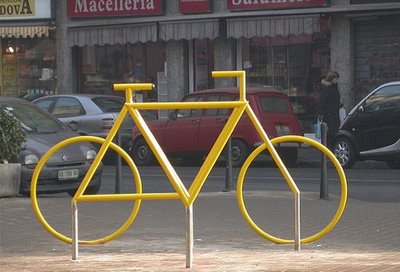
This yellow bicycle sculpture is located in Milan, Italy, a city best known for fashion. While it does not look particularly special, it happens to be an optical illusion. Can you figure out what is going on?
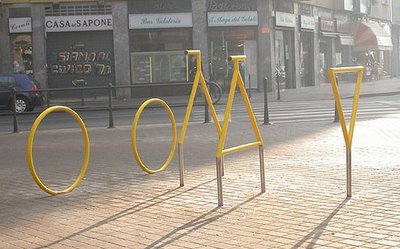
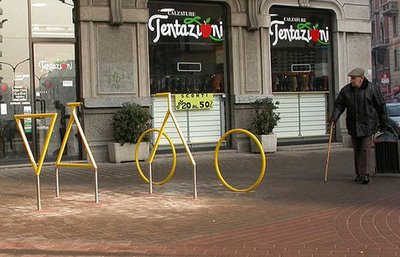
The two photographs below show how the artist created this sculpture. From two specific viewing points, it looks like a bicycle. From all other angles, it is obvious that the sculpture is comprised of five different pieces that are spaced apart.
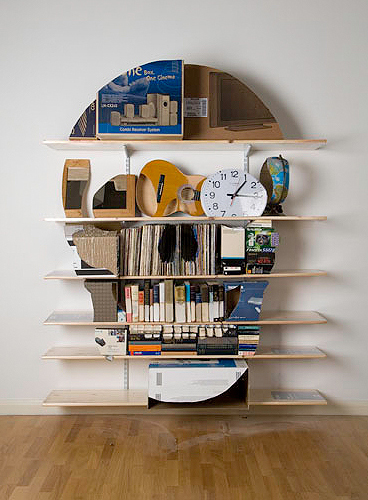
British artist James Hopkins transforms everyday items into sophisticated illusions. His work below, titled “Shelf Life”, was created in 2006 for a private collection. Does the bookshelf resemble something else?
To learn more about James Hopkins and view more of his works, please visit JamesHopkinsWorks.com.


 Loading...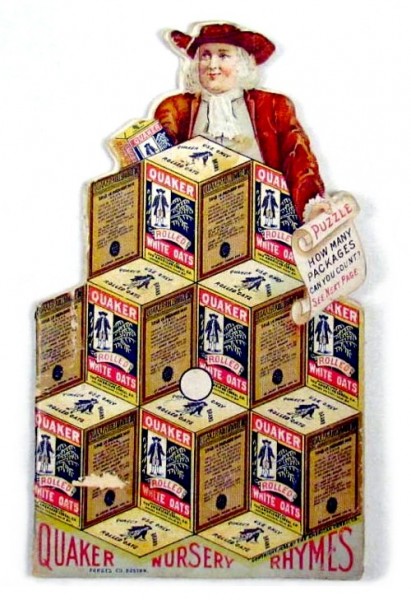
 (2 votes)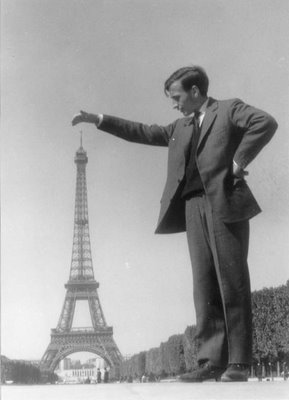
 (2 votes)