Like many others, I am a big fan of 3D sidewalk chalk art and enjoy featuring it on the site. I am not exactly sure who the artist behind this one is, but would love to find out. If you know the artist, please let us know in the comments. This artwork really brightens up an otherwise dingy alley and the kid in the photograph appears to be enjoying himself.
Two red hearts are presented below on a blue background. One of the hearts is “blurry” and the other is not. As you move your eyes back and forth between them, the blurry heart appears to wobble (as if it were unstable) while the solid red heart does not.
This illusion was presented by Kohske Takahashi, Ryosuke Niimi & Katsumi Watanabe from the University of Tokyo (Japan) in 2010. It was also selected as a finalist in the 2010 Best Illusion of the Year contest.
Can you find the hidden image on the surface of Mars in this stereogram created by 3Dimka?
If you are having trouble finding the hidden image, try reading through the stereogram viewing tips at 3DStereograms.com. They should help get you on the right track.
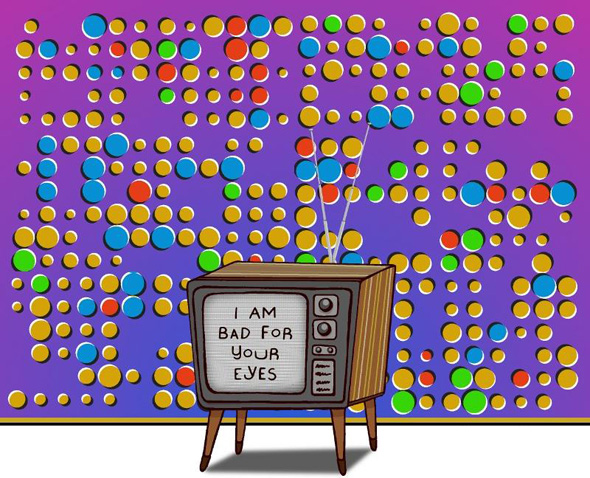
We’ll start off 2013 with a very colorful and powerful motion illusion. The circles appear to swirl all around the purple background. The television set in the middle says “I am Bad For Your Eyes”. Is this message talking about the illusion or the TV itself?
Happy New Year! Everyone enjoys a good Top 5 list, don’t they? Based on your ratings and feedback, here are five of the most popular optical illusions posted on An Optical Illusion in 2012:
Today’s video will demonstrate how certain visual cues help your brain to create the perception of depth. Two playing cards are presented, but the one that appears to be furthest away is actually closer to you than the other.
Look at the center of the following figure and move your head closer and further from the figure repeatedly. Does the “white spot” toward the center of the image appear to get larger and smaller?
The effect seen above has also been called the “here comes the sun ” effect and is caused by a change in the apparent brightness. More information about the Dynamic Luminance Effect can be found on PerceptualStuff.org run by D. Alan Stubbs.



 (5 votes)
 Loading...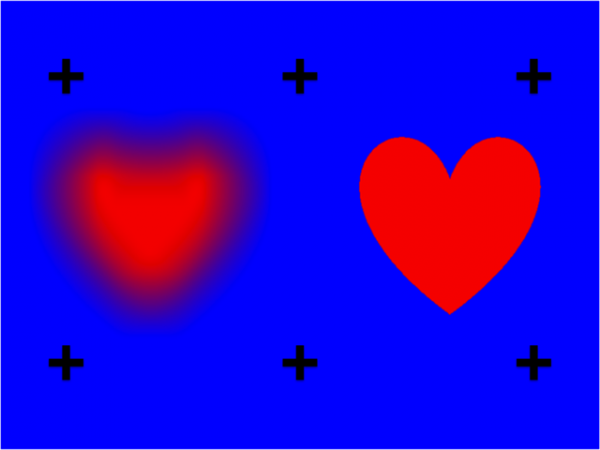
 (4 votes)