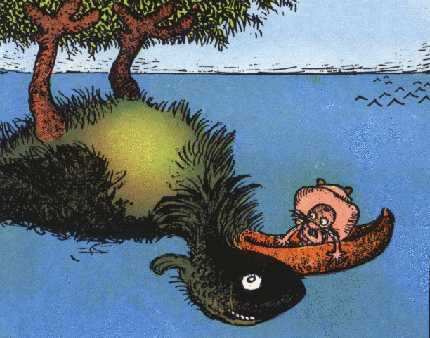
From 1903 to 1905, the New York Herald ran a series of original comic strips called The Upside Downs of Little Lady Lovekins and Old Man Muffaroo. This comic strip, created by cartoonist and illustrator Gustave Verbeek, consisted of a total of 6 drawn panels. After reading the 6 panels right-side-up, the entire comic could be turned upside down to reveal an additional 6 panels that continued the story (bringing each comic to a total of 12 panels). That Gustave Verbeek completed a total of 64 such upside down comic strips over a two year time period is a testament to his creativity and resourcefulness.
Perhaps the most famous image from The Upside Downs of Little Lady Lovekins and Old Man Muffaroo is one that shows Old Man Muffaroo in a canoe being attacked by a fish.
Continue reading this post to view how this image looks when inverted.
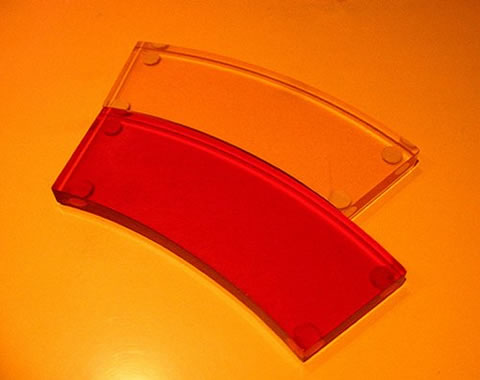
In the image below, the red object on the bottom looks significantly larger than the orange object on the top, right?
Believe it or not, both objects are the exact same size. This illusion was discovered by American psychologist Joseph Jastrow in 1889. As such, it is often referred to as the Jastrow Illusion.
EDIT: The above photograph of the orange and red objects was taken from an angle. So if you print out this specific image and then cut out each object, they will be different sizes. Had the photograph been taken from directly above the objects, it would work. Located below is an alternate version of the Jastrow illusion. Feel free to either trace the two objects or print and cut them out. Object B appears to be larger than Object A, but they are identical in size.
Below is a video that also helps to demonstrate this illusion.
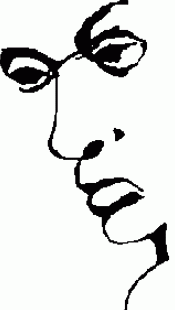
Shown here is the face of a man gazing to the left. But there is also a secret double meaning. Can you find the liar hiding in this portrait?
Many sites do not properly attribute this illusion or leave the source either blank or unknown. This figure was drawn by a New York artist by the name of Paul Agule.
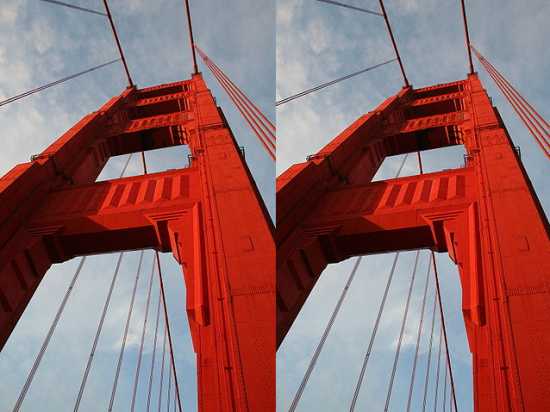
Do the two pillars on the Golden Gate Bridge appear to be parallel or skewed?
The photograph on the left and right are identical. Therefore, the pillars must be perfectly aligned and parallel. For most people, it appears that the images are skewed. That is, the picture on the right is at a much sharper angle than the picture on the left.
The illusion was discovered by Frederick Kingdom, Ali Yoonessi and Elena Gheorghiu at McGill University. In their version, an image of the Leaning Tower of Pisa was used to demonstrate the effect. As such, this effect is commonly referred to as the “Leaning Tower Illusion”. This discovery won the trio first prize in the Best Visual Illusion of the Year Contest in 2007.
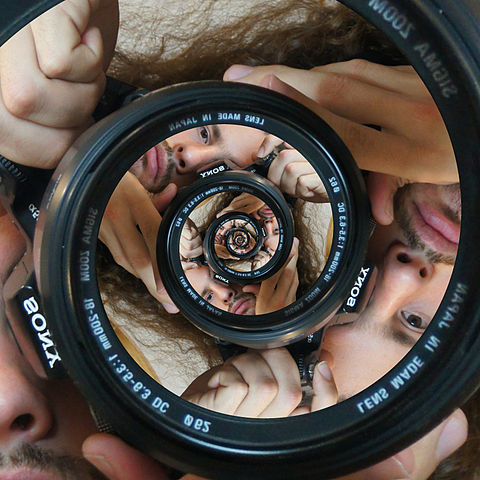
A Droste Effect is a term with Dutch origins that refers to a recursive image where seemingly never-ending smaller versions of an image appears within the image itself. Some, such as the one below, have an almost strange and uneasy feel to them. I suppose that this is what infinity looks like.
Continue reading this post to learn a little more about the origins of the term “Droste Effect”.
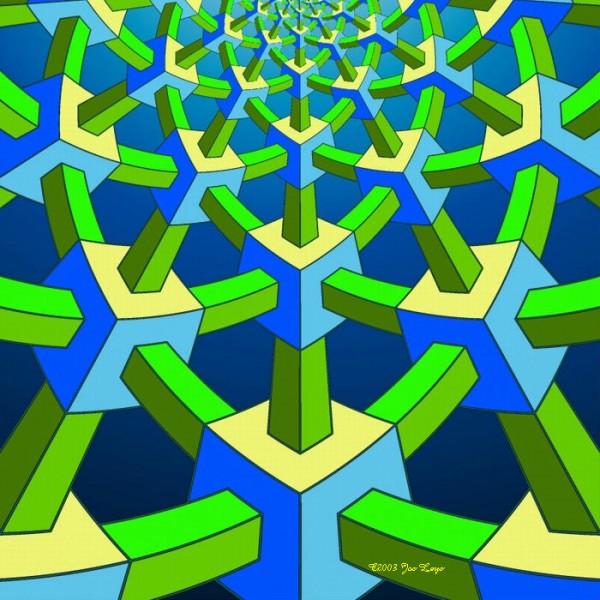
Jos Leys created the following impossible pattern taking inspiration from both Oscar Reutersvärd and M.C. Escher. These cubes could not possibly be connected to one another in this way.
To see more impossible geometry, fractals and other works from Jos Leys, please visit his site.


 Loading...


 (2 votes)